


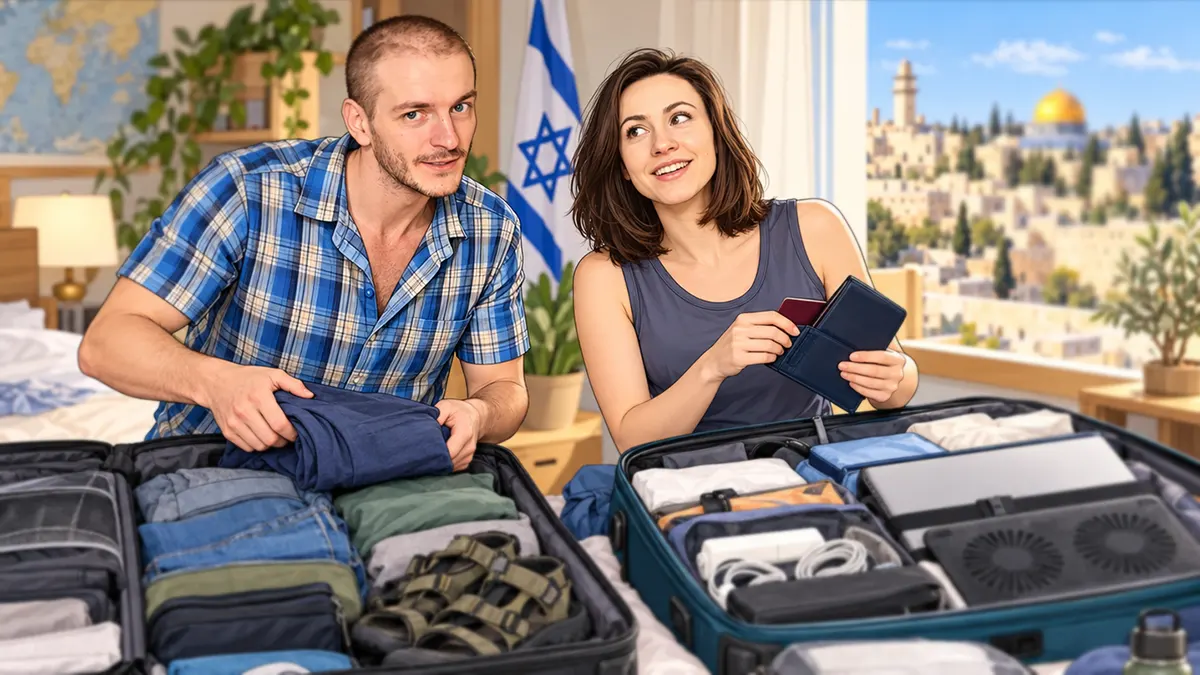
When you’re getting ready to move to Israel, one big question comes up: how much stuff should you bring? Can you get by with just one suitcase, or should you try to move your entire household?
My husband and I moved to Israel as new immigrants (olim) with barely more than carry-on luggage. And we quickly realized that some things we’d left behind were actually worth bringing. Meanwhile, a lot of the stuff people haul across the world in giant suitcases can easily be found in Israel, sometimes completely free.
In this article, I’ll share what I’d actually recommend packing for a move to Israel, which things I regret leaving behind, and why I wouldn’t rush to ship all your belongings if you haven’t figured out where you’re going to live yet.
I’ll also cover a few less obvious essentials that are especially useful in Israel, from a laptop cooling pad to warm clothes for surprisingly chilly apartments in winter.
How Much Should You Pack When Moving to Israel?
My biggest piece of advice: if you don’t have a permanent place to live yet, don’t rush to bring everything you own.
On our flight to Israel, there was a couple ahead of us who seemed to have about ten suitcases and several cats. We, on the other hand, arrived with almost nothing. And for the way we planned our move, that turned out to be the right decision.
The thing is, we didn’t settle on a city or an apartment right away. We stayed in different places, rented short-term accommodations, and gradually figured out where we actually wanted to live. Moving around with a mountain of luggage would have been much more complicated and expensive.
Another thing worth knowing is that giving away unwanted stuff is pretty common in Israel. People pass along furniture, dishes, household items, clothes, and all kinds of other things for free. There’s a catch, though: free stuff isn’t necessarily available exactly where and when you need it. So showing up without even the basics isn’t particularly convenient either.
In my opinion, the best approach is to bring what you’ll need for your first few weeks, then figure out bigger purchases and shipping arrangements once you’ve found a place to live.
What to Pack for Your First Weeks in Israel
Here’s our personal list of things we always make sure to pack when traveling to Israel:
- Documents, money, and keys
- A lightweight backpack
- Rubber shower sandals
- Sneakers and sandals
- Phone, laptop, and chargers
- A laptop cooling pad
- Warm socks and clothes
- A cup, bowl, and spoon
- A raincoat and umbrella
Of course, this isn’t a one-size-fits-all packing list. A lot depends on the city, the season, where you’re moving, and how long you’re planning to stay. But for us, these are the essentials we pack first.
Rubber Shower Sandals: One of the Most Useful Things to Bring
Let’s start with something people seriously underestimate.
Bring a pair of simple rubber slides that you can wear in the shower. They’re especially useful if you’re planning to spend your first few weeks in a shared apartment, dorm, or other temporary accommodation. When several people share a bathroom, walking around barefoot isn’t always appealing. And regular fabric slippers get wet quickly and aren’t great for these situations.
I’ve had my rubber slides since I lived in the Netherlands, and they turned out to be just as useful in Israel. Look for something lightweight that’s easy to rinse off and dries quickly. You can wear the same slides outside when it’s warm or take them to the beach. Give them a quick rinse and voilà, they’re your house shoes again. They’re especially handy in winter, when the floors can get really cold even if you’re heating the apartment with the AC.
A Lightweight Backpack for Shopping and Everyday Errands

When you’re already trying to pack light, bringing an extra backpack might seem unnecessary. But I’m not talking about a huge hiking backpack. I mean a small, thin daypack that’s so lightweight you barely notice you’re wearing it.
It’s incredibly useful in Israel. You can throw in a bottle of water, a sweater for the evening, folders with documents, and a phone charger. It’s much more comfortable than carrying everything in a shoulder bag or plastic shopping bags. During your first weeks in Israel, you’ll probably be running errands constantly, carrying one set of documents to one office and another set somewhere else. You can also pack a snack from home.
And if you decide to go sightseeing or head to the beach, you’ll need a backpack anyway. Keep in mind that it’s hot much of the year, so we bought the lightest, thinnest one we could find. It’s practically just a piece of fabric, but it still fits an A4 document folder and all our essentials. The main things are that it’s sturdy and has a zipper.
A Laptop Cooling Pad: Definitely Worth Packing!

Summers in Israel can get extremely hot, especially if you work from home. In those conditions, your laptop may run hotter, get noisier, and start slowing down. If you spend a lot of time working on your computer, editing videos, gaming, or running demanding software, it’s worth bringing a laptop cooling pad with built-in fans or another suitable cooling solution.
That said, if your laptop doesn’t normally overheat, you might be fine with a basic stand that raises it off the desk and improves airflow. We actually use two empty cardboard egg cartons to prop up our laptop. You can also add a USB-powered cooling fan underneath.
Even if you cool your apartment with air conditioning, you might go out for a walk and leave your laptop running at home. After a couple of hours without the AC, the room can get hot enough that your computer may overheat. That’s why I wouldn’t recommend leaving a laptop running unattended in a hot apartment without adequate cooling. I actually ended up damaging some of my equipment while doing a lot of video editing in the heat.
Clothes: You Don’t Need to Bring Your Entire Wardrobe
Another thing I learned after moving is that packing giant bags full of clothes isn’t always worth it. Israel has thrift stores, charity shops, clothing exchange groups, and places where people give away unwanted clothes for free. I’ve personally found some really nice clothes without paying a cent. So if you’re comfortable shopping secondhand, you can cut down your luggage quite a bit.
For the first few weeks, I’d pack a few T-shirts, enough underwear and socks, comfortable everyday clothes, and shoes appropriate for the season. What surprised me most was how important warm clothes are: socks, gloves, a hat, and a scarf. Yes, Israel can actually get cold in winter, and you’ll feel it both outside and inside your home. That’s why plenty of Israelis sleep under several thick blankets and wear warm, fluffy pajamas.

The climate varies from city to city, and many Israeli apartments don’t have the kind of central heating that’s standard in Russia. Instead, you might rely on an air conditioner with a heating mode or a portable heater. How heavy a winter jacket you’ll need really depends on where you’re living. Jerusalem and the mountainous areas are a different story from coastal cities or Eilat.
Sport Sandals: More Important Than You Think
One thing I definitely regretted leaving behind was my comfortable sport sandals. I had an old but perfectly usable pair at home, and I figured they weren’t worth packing. So I traveled in sneakers instead. Once I got to Israel, I quickly realized that wearing closed-toe shoes all the time gets pretty uncomfortable in the heat, even if they’re lightweight summer sneakers.
That’s why I’d recommend bringing two pairs of shoes: comfortable sneakers for your flight, longer walks, and cooler weather, plus a pair of open, supportive sport sandals with soft, sturdy soles. I’m talking about sandals you can comfortably walk around the city in for hours, not just flip-flops for a quick trip to the beach.
Document Folders and Basic Office Supplies
One of the smartest things we packed was a few sturdy document folders. Once you arrive in Israel, the paperwork can really start piling up: documents related to your immigration status, banking, healthcare, renting an apartment, and other administrative tasks. And you need somewhere to keep all of it.
I brought several folders, which made it easy to organize everything without crumpling or losing important papers. I’d recommend sturdy folders, clear plastic sheet protectors, a pen or two, and a separate waterproof pouch for original documents. It’s also a good idea to make digital copies of important paperwork before you leave and store them somewhere secure that you can still access after moving.
Toothbrushes, Makeup, and Your Favorite Personal Care Products
You can absolutely buy toothpaste, shampoo, and other toiletries in Israel. The problem isn’t that these things are unavailable. It’s that right after arriving, you’ll have to figure out unfamiliar stores, brands, and prices. So I’d bring a small supply of the products you’re already comfortable using.
For example, your favorite toothbrush, makeup in a shade that works for you, or skincare products that are hard to replace. There’s no need to haul huge quantities of ordinary household supplies across the world. But if there’s a particular product you really don’t want to live without, check whether it’s sold in Israel before you leave.
Equipment for Work, Video Production, and Blogging
Another packing mistake I made was leaving some of my blogging equipment at home. My tripod, for example. While I was packing, all those little accessories seemed bulky and heavy. But almost as soon as we arrived, I realized I needed my tripod right away.
So think about what you actually use for work, hobbies, and everyday activities. If you make videos, that might mean a compact tripod, a lavalier microphone, a phone mount, or spare cables.
If you work remotely, consider bringing a mouse, headset, necessary adapters, and an external drive. You don’t need to bring your entire professional setup, but compact accessories you use every day are definitely worth packing.
Sun-Protective Clothing and Your Favorite Sunscreen
Sun protection is especially important in Israel’s climate. If you already have a lightweight, long-sleeved shirt made from natural fabric, a sun hat, sunglasses, and sunscreen that works well for your skin, bring them along. And most importantly, a big umbrella! Yes, an umbrella can protect you from the sun, too.
Unexpected Things Worth Bringing to Israel
Here’s something we didn’t pack and regretted: my prescription glasses for driving. It turned out that getting an Israeli driver’s license involves taking another vision test. And if you show up without your glasses, you may end up having to order a new pair based on your prescription.
I was also disappointed that I hadn’t brought my keyboard. Editing videos on a laptop without a full-size keyboard turned out to be pretty inconvenient. Fortunately, smaller things like that are easy enough to buy once you’re there.

What Should You NOT Bring When Moving to Israel?
In my opinion, there are a few categories of things you really don’t need to rush to bring:
— Too many clothes. If you’re comfortable shopping at thrift stores or using local giveaway groups, bringing your entire wardrobe might just mean hauling around a lot of unnecessary weight.
— Everyday kitchenware. Plates, mugs, pots, pans, and other basic kitchen items can be found once you arrive. High-quality cookware or specialized kitchen equipment you use all the time is a different story.
— Large kitchen appliances. Things like a multicooker, coffee machine, or food processor are easier to deal with once you know where you’re going to live and whether you’ll actually have space for them.
— Furniture. If you haven’t rented a permanent apartment yet, shipping furniture ahead of time could make your move much more complicated. Honestly, I can barely imagine a situation where shipping ordinary furniture internationally would be worth it, unless we’re talking about valuable family antiques.
Of course, these recommendations mainly apply if you’re arriving without a permanent place to live. If you’ve already secured a long-term apartment, that’s a completely different situation. In that case, bringing more of your familiar belongings can help you settle in comfortably from day one.
What Would I Pack If I Were Moving to Israel Again?
If I could go back to the day before our flight and repack my bags, honestly, I wouldn’t change all that much. I still wouldn’t bring my entire wardrobe, kitchenware, or household appliances. I’d pack a small backpack with clothes and electronics, throw in about ten of my favorite toothbrushes (they’re much more expensive in Israel), and definitely bring a decent laptop cooling solution. When you’re working in a hot apartment, it’s something you’ll really appreciate.
Ultimately, it all depends on how you’re planning your move. If you’ve already rented an apartment for the long term, bringing more of your belongings makes sense.
But if you’re like us and want to spend some time exploring different cities and neighborhoods before deciding where to settle, traveling light can make those first few months a whole lot easier.
The key is to pack what you’ll actually use right after arriving and what would be difficult to replace, not everything you’ve accumulated over the years.
Frequently Asked Questions
What Should I Bring When Moving to Israel?
Start with your documents, money (while following applicable currency regulations), essential electronics, chargers, comfortable shoes, weather-appropriate everyday clothes, personal care products, and any medications you need, making sure you follow Israel’s import rules. If you’re staying in temporary accommodation, rubber shower sandals are especially useful.
Do I Need a Winter Jacket in Israel?
It depends on where you’re moving. Winters are relatively mild but rainy in many parts of Israel, while mountainous areas can get considerably colder. For everyday life, having several warm layers is often more practical than bringing one extremely heavy winter coat.
What Things Are Expensive in Israel?
A lot of everyday products can cost around three times as much as they do in Moscow. That’s why it’s worth comparing prices on Israeli online stores ahead of time or asking locals what things currently cost. If you use expensive cosmetics or have a favorite toothbrush, stocking up before the move might make sense. The same goes for glasses, contact lenses, and various other personal items. But not every product category is more expensive, so it’s best to compare prices based on what you actually use and need.
Can I Move to Israel With Just Carry-On Luggage?
Absolutely! That’s exactly what we did. Even though new immigrants are generally entitled to a generous baggage allowance under applicable relocation arrangements, there’s nothing wrong with traveling light if that’s what you prefer. It’s especially convenient if you’re staying in temporary accommodation or want to try living in different places before settling down. You won’t be stranded without your belongings in Israel. You can buy just about anything you need, and there are also plenty of places where people give things away for free.
Have you moved to Israel? What do you regret leaving behind, and which things turned out to be surprisingly useful? Share your experiences in the comments! I’d especially love to hear about things that are difficult to find or unusually expensive to buy in Israel.